B-Spline Policy
July–August 2026 · internship at SEEN-E
My role: Paper reproduction, model training and inference, simulation and real-robot experiments, algorithm improvements
I completed this embodied AI demo during my internship at SEEN-E in July–August 2026. Using a simulation environment and the company's real-robot setup, I attempted to reproduce B-spline Policy by Han, Xiong et al., then improved the algorithm in response to issues found during reproduction. The project gave me practical experience with embodied model training, inference, robot-arm control and the engineering connections between them. Below are simulation results at different execution speeds and a real-robot comparison of smoothness at action-chunk boundaries.
Simulation results
Compare the 1×, 2× and 4× simulation results side by side. Moderate acceleration brings a clear efficiency gain, while pushing beyond a certain limit becomes counterproductive. Each recording preserves the original result and can be played or downloaded separately.
1×
2×
4×
Real robot experiments
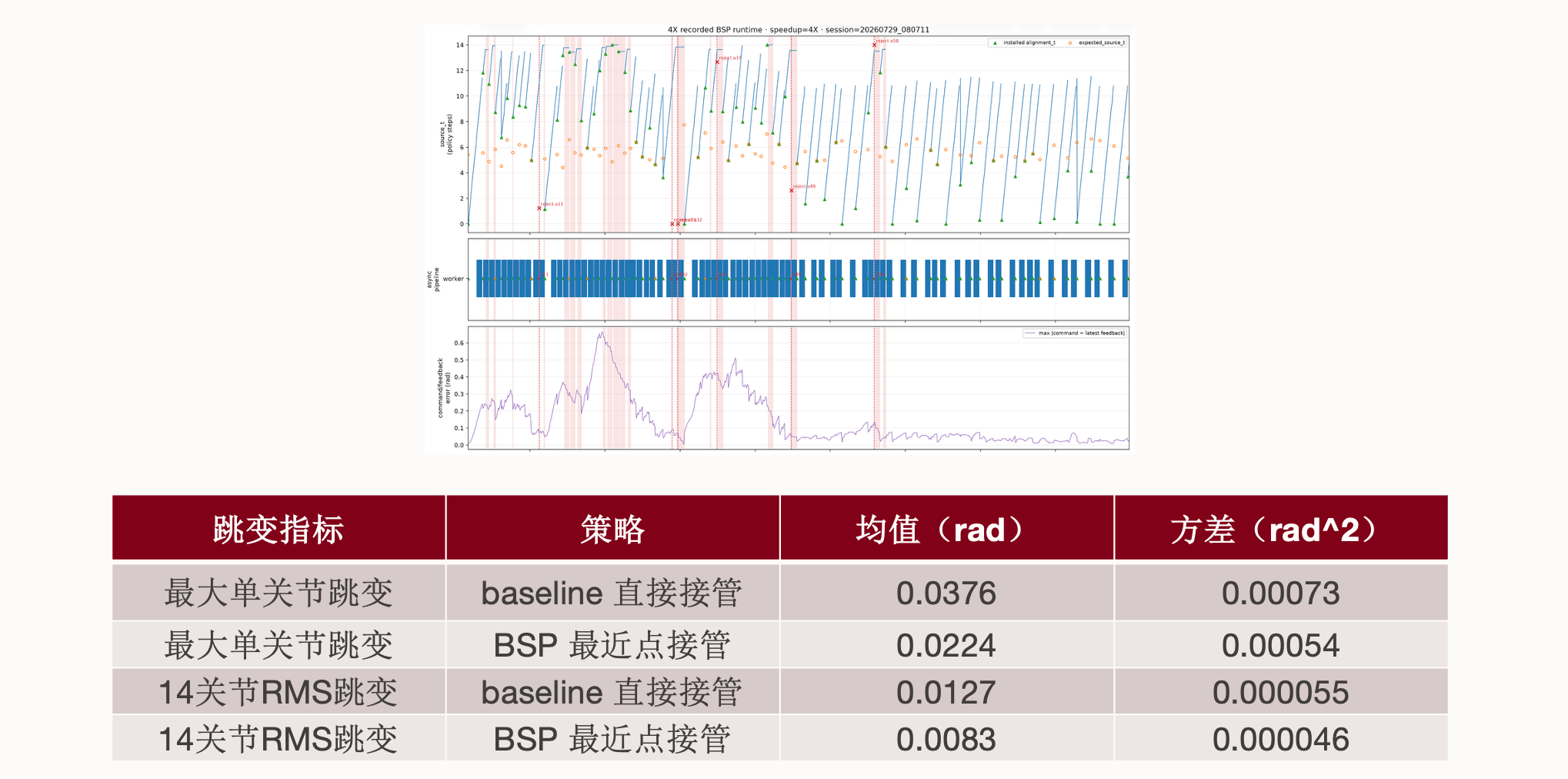
In this real-robot experiment, BSP nearest-point handover has lower means and variances for both jump metrics than direct baseline handover, indicating smoother transitions between chunks. These observations apply to this experiment, rather than every task or speed setting.